
There's no AAA in Space
From launch to recovery, the satellite lifecycle is building a new economy in orbit


Special thanks to Tron for mentioning Astroscale last night and sending me down a 12 hour research rabbit hole. More and more names in the M&C Private Company Tracking Database.
What happens when a satellite fails? Interestingly enough, it doesn’t get repaired or towed, there isn’t even a “space tug” to push it out of the way. It just kind of stays there.
For decades this was a manageable outcome, but what started as dozens and then hundreds of satellites, is now between 13,000 to 15,000. The luxurious tolerance for errors and failure has slipped away as we built a commercial space economy with launch providers like SpaceX and Rocket Lab reducing the barrier to off-world services by taking out millions to the cost of launch. By some estimates, these companies have reduced these launch costs by 90%-95%.
This drastic change meant that companies like SpaceX and Planet Labs were able to scale LEO constellations to thousands of satellites in a relatively short period of time. What was a quaint little block party at the edge of Earth’s orbital influence, became Coachella for the new tech regime, delivering essential services for a diverse set of industries from emergency response and monitoring of critical infrastructure to defense mapping and intelligence and logistics.
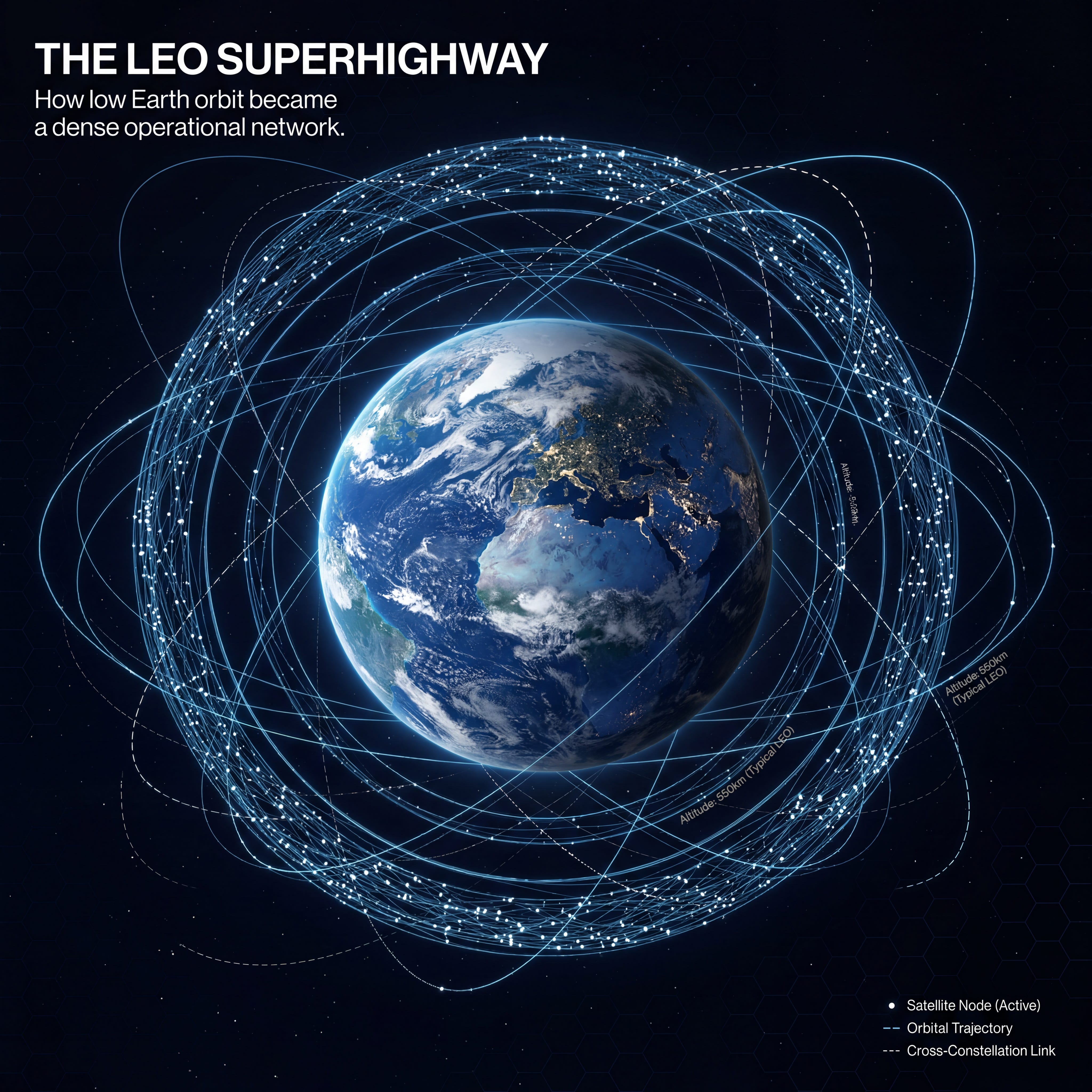
This is what we built.
It is a dense, layered system of satellites moving across overlapping orbital paths. Communications, imaging, navigation, and defense. All operating in the same constrained environment.
For the most part it works incredible well, and space, as treacherous as it is, can be forgiving for well engineered failures. Or, at least it could be until the parking lot was full and there was no one around for a push.
If you aren’t familiar with the Space Turnpike, I should probably start here with a little background on what things look like from an operational lifecycle view.
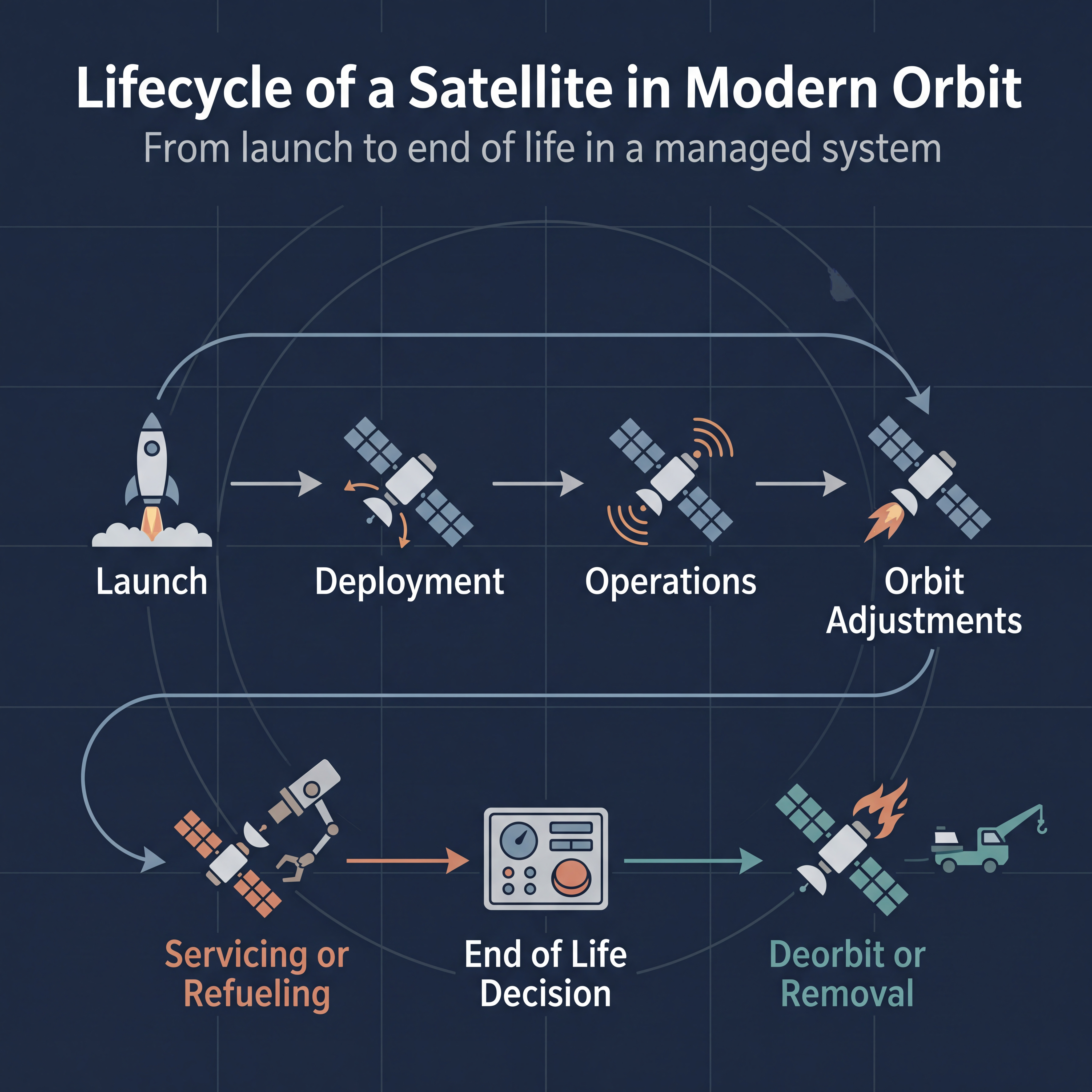
Everything starts with getting there. This used to be the hardest part. Now, we have complex operations, contractual service delivery requirements, adjustments and maintenance, and finally end-of-life planning and deorbiting.
It’s a somewhat clean plan, as space engineers would like it to be. However, the harshness of the operating environment, human built technology and systems software, and about a million other things that can go wrong, the probability tables eventually win and something happens.
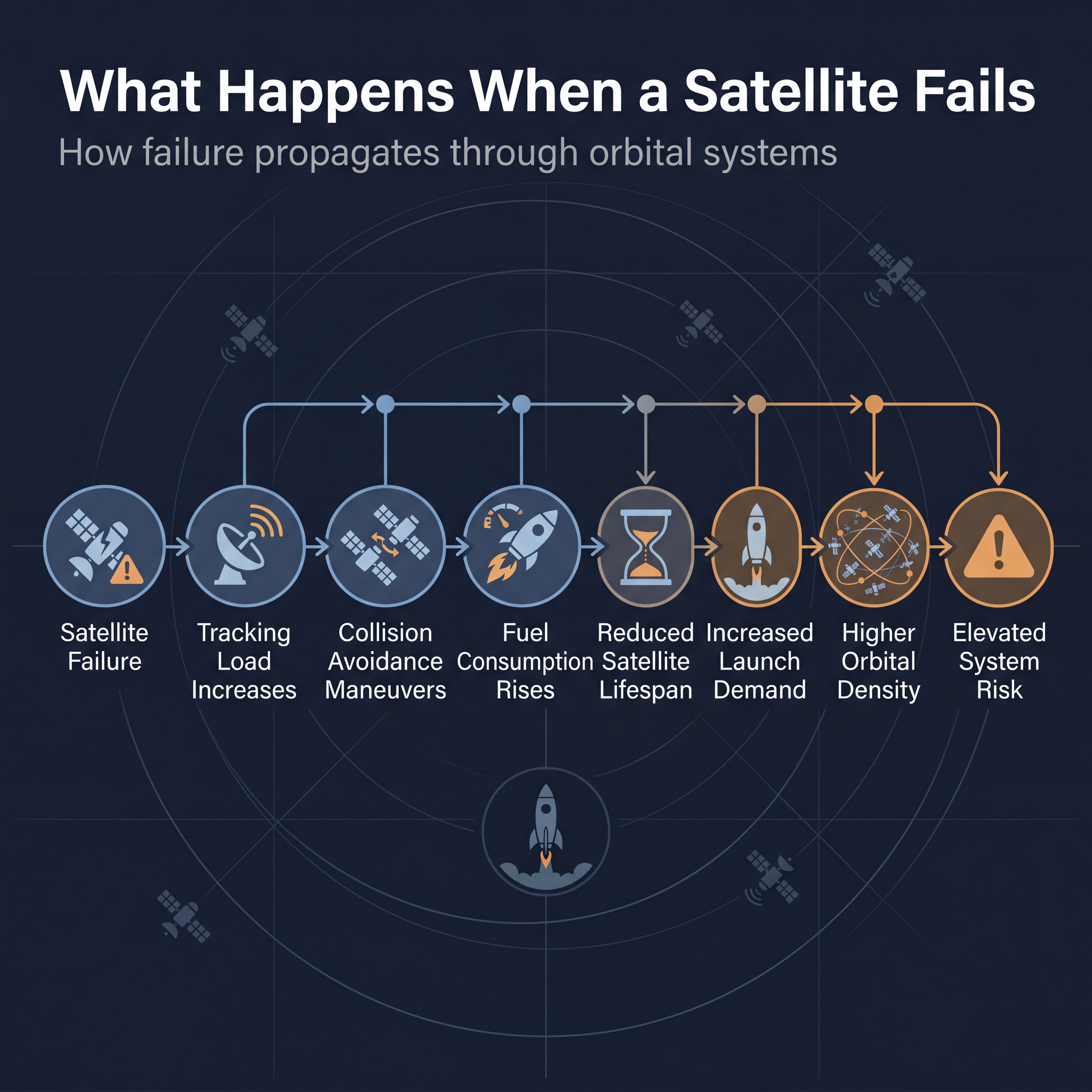
When we have a failure in space, it kicks off an entirely new set of processes. We need to make sure that the satellite is tracked, monitored, modeled, and absolutely avoided. This requires coordination with other operators to adjust their satellite paths to keep clear. Among other issues, this creates an unintentional or unplanned use of fuel resources. This actually impacts lifespan for these satellites as fuel equals life in space.
This feeds right back into the failure workflow as we now have shorter orbital durations, satellites that need to come down, increased launch windows to replace the aging or disables units, and so on. It’s a ripple effect from one failure that can cause a lot of downstream work requiring a lot of coordination and solutioning.
I would like to think that smart people and organizations have thought of this, and they have. Unfortunately, its not like we have a AAA in space. We have an ecosystem of mostly newer and some existing companies and services to manage various aspects of our orbiting service delivery model.
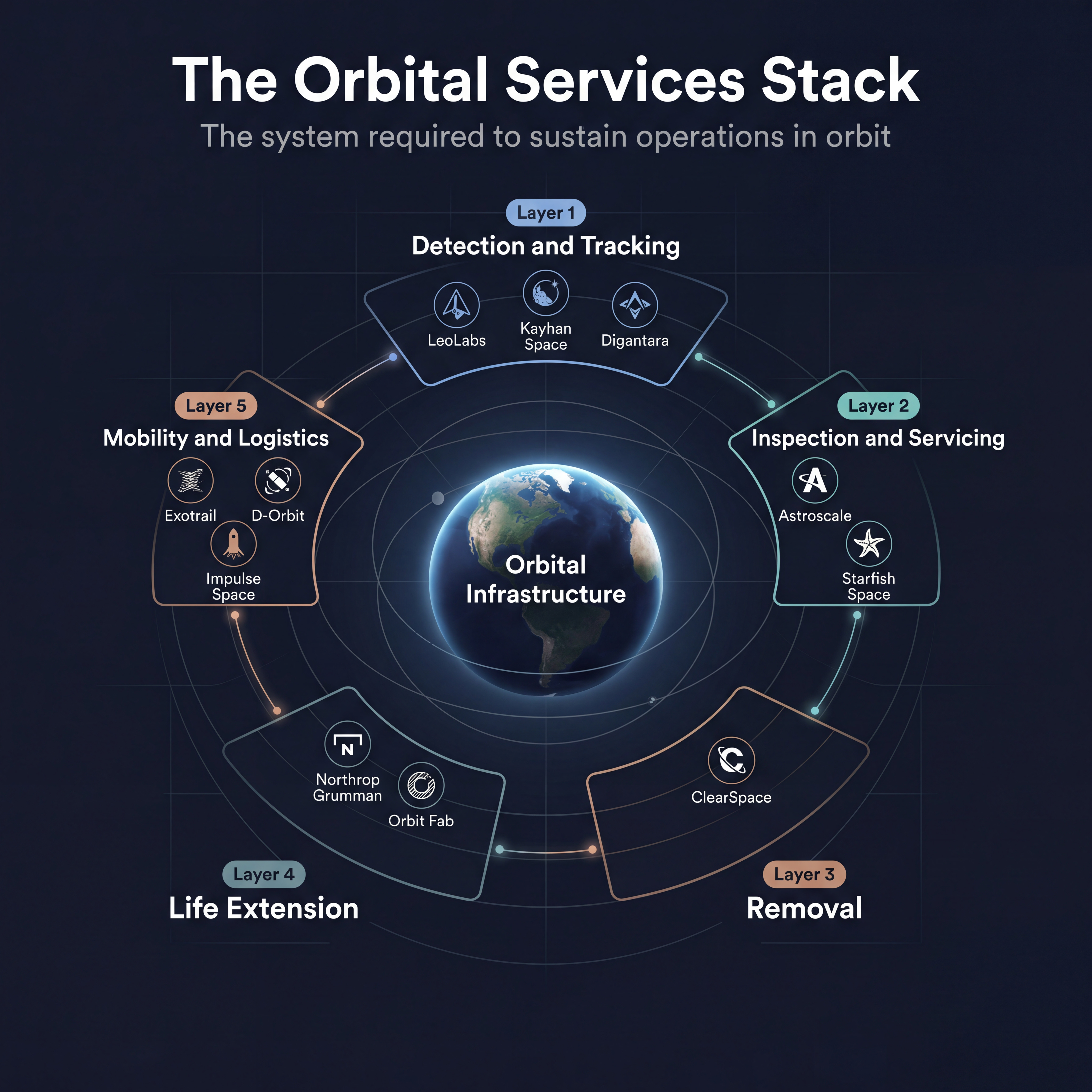
LeoLabs operates orbital radar networks that track space objects. It’s a commercialized service, with tens of millions in contract awards and growing government demand. Kayhan Space provides coordination software used by dozens of operators to manage conjunction risk and plan maneuvers. The detection and tracking of space range objects and vehicles is up, functioning, and mostly private.
Beyond finding things in space, we have to be able to take a look and possible service them. Astroscale (were this overnight boondoggle of a article started) has demonstrated proximity operations around space debris and secured government contracts for removal missions. They have a repeat customer in the Japanese space agency and are working with others as well. Another player in this area is Starfish Space. They are earlier but already winning meaningful contracts, including a $50M+ award tied to their satellite disposal capabilities. Between the two companies, we have more than $100M in active contracts, which feels like a meaningful watch signal.
But what about removal of the devices that can’t be helped or moved. This is where ClearSpace comes in with debris removal efforts. They have funded missions to capture and deorbit satellites, safely and effectively, away from human populations. Some might argue this is the most critical part of this ecosystem, but time will tell.
Bringing a unit out of space means something different of course. If its no longer in space, it’s no longer earning revenue from it’s designed purpose. Many operators would like to avoid this outcome at all costs. Enter the only real whale in the space, Northrop Grumman. They have been providing orbital maintenance for a while with its Mission Extension Vehicle that can dock with satellites and extend their usable life. They have brought practicality to an impractical place, resulting in extended service lives and a model for long-term service delivery maintenance.
The last part of this cycle involves what I think of as “exceptions”. What do we do with he orbital units that aren’t functioning, but shouldn’t or can’t be brought back to Earth for whatever practice or business reasons? Companies like Exotrail, D-Orbit, and Impulse Space are building the abilities to move these units that can’t be managed. This diverges from removal and converges with logistics and monitoring. The unit stays in space, is moved further away, and into less crowded and more predictable orbit vectors. It’s not the most elegant solution, but its is necessary for the state of our capabilities.
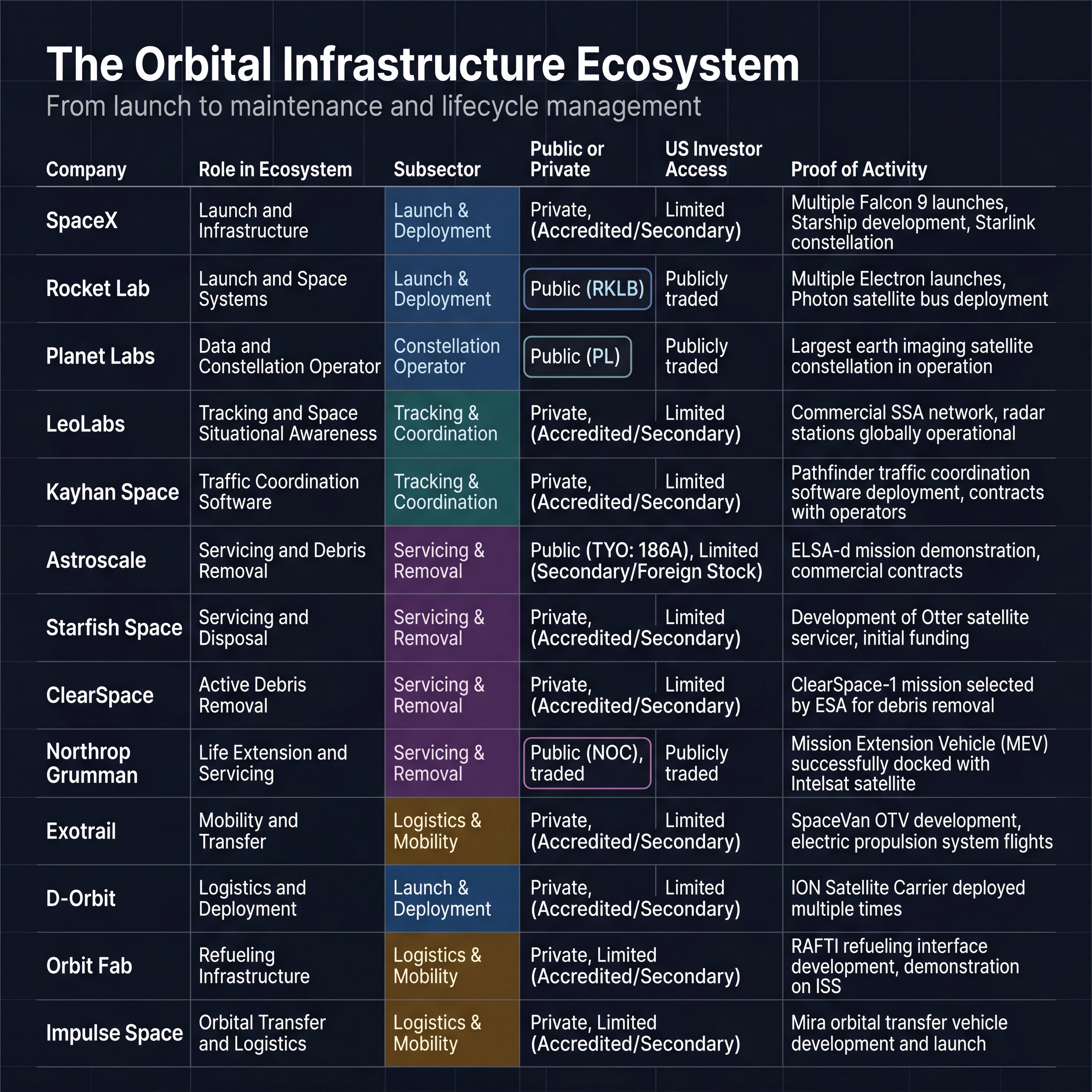
There are a lot of invites to the party these days. As we transitioned from space as a “Government Only” field of play with only countries and their contractors to privatized use cases and service delivery, it was only natural that friends and friends of friends would arrive.
This inventory and mapping of players is pretty early. Most of these entries are small and nearly all are private. Most, if not all have demonstrated capability, won contracts, and earned extensions or new business. Now, we are the ones monitoring and waiting to see what comes next.
I’ve got a view on that, but not many names. In two to three years, we could start to see refueling business arrive for companies gearing up to work beyond LEO. We could also begin to see orbital transfers shaping up as either waypoints or permanent missions. As we begun to industrialize the Moon, and granted this could be ten years out, cislunar logistics and the related supply chain will take shape. I think its important that we think about this because the companies that are building now will likely be foundational to the next phase, especially those that prove their platforms are reusable.
Today, I look at what we built, the LEO superhighway, and realize that we never were going to have a AAA in space. There will be a whole network though that replaces that view with a diverse set of systems and services that function exactly like a AAA would. And once that system is in place, it removes the barrier to supporting our work beyond the LEO, into he lunar, and beyond.
AI disclosure: AI tools were used to generate images, which were reviewed by me, a human. Errors may be present.
General disclosure: This article is written for discussion and educational purposes only. No other purpose or intent is implied.
 | A guest post by
|
You’re telling me that we possess the unparalleled genius to launch thousands of complex, multi-million-dollar supercomputers into the dark void of space... but our current backup plan for when one breaks down is basically the equivalent of leaving a '98 Civic with its hazard lights on in the middle lane of the I-5?
We just need to launch a guy in a beat-up orbital tugboat with a flashing yellow light on top.
"Yeah, buddy, looks like your solar array is shot and your alternator is toast. I can tow you down to the atmospheric incinerator, but you're out of network so it's gonna be a $4 billion out-of-pocket co-pay."